Friday, April 28, 2006

What Next I Need


For September. In the teaching department. I'm starting to look early, because I need at least 15 thumb pianos. Not to mention several pairs of Cothurni, but I don't think you'll be able to help me with that.

Speaking of thumb pianos, if you want to hear some good TP trance pop, "neurotic sci-fi folk for the whole family", check out this 102 year old woman.

Thursday, April 27, 2006

Hollow Man


I just found a website for John Millard and his band Happy Day. I'd never seen it before and it looks like he hasn't touched it in awhile. Funny these abandoned houses on the net. Except it's not so abandoned. It's got a page with two or three mp3's on it. I'm going to link one of them here – Hollow Man – since it's one of my favourite songs and I'm thinking of swiping the title to use as the title of a novel I'm writing about a pair of musicians.
This album has got more great songs on it then would be normally desirable or even respectable. If you like the banjo or if you like to get your heart twirled and your ear opened, you should get it. I believe it's just called John Millard and Happy Day. And if anyone has a problem with me linking mp3s, let me know and I'll take it down.

Wednesday, April 26, 2006

whodathunkit


So it looks like none other than the Boss has jumped up on the long neck banjo bandwagon.

Also, it seems that a certain masked blogger has inspired me to resuscitate this blog, even if I am blogging with old news.

Jane Jacobs


What the world needs now, it seems to me, and contrary to the opinion of at least one masked blogger, is a serious look at Jane Jacobs' Systems of Survival. If this book were heeded, if it were rated at all, nevermind overrated, there would not be big problems like torturers under private contract in Iraq getting away with murder while military grunts are scapegoated, there wd be no Halliburton for that matter; nor would there be little problems like competing gas co's coming to your door and trying to rip you off, all the while pretending to represent a public service.

Overrated. What a joke.

Tuesday, February 07, 2006

John Millard & Canada


Nice cover image. The boy's going to put a birdhouse up, but on stage, not in real life. Here's an email from John Millard, Canada's own latter day Uncle Dave Macon, i.e. the country's most innovative and celebratory banjo player (I tried once to pen a mock-epic ballad about the demise of his first band, the Polka Dogs - I only got about halfway through), this morning:

On Tuesday February 14 2006, come to THE RED GUITAR at Markham and Bloor and enjoy:

A PEOPLE'S FAME

John Millard's brand new renditions of Canadian folk songs. Performed by John Millard's trio featuring Tania Gill on piano, Jay Burr on Tuba and John Millard on banjo, cittern and vocals.

Sets at 9 pm and 10:30 pm

Students, Seniors, Artists at $6 and Everyone Else at $10.

While not an official release party, this should be considered a pre-release event and the new cd "A People's Fame" will be available.

Over the last three years, I have visited some of the biggest collections of folk songs in this country including The Canadian Museum of Civilization, The Edith Fowke Archive and the University of Calgary and The Phillip J. Thomas Collection of Popular Songs at the University of British Columbia. During this time, I have dug out what I think is a great collection of known and unknown Canadian songs and arranged them for this group of people.

These are the people who play on the cd:

Mark Duggan on Percussion
Don Kerr on Drums
Dragoslav Tanascovic on Accordion
Monica Federigo on Cello
Julia Hambleton on Clarinet
Pamela Bettger on Viola
Tania Gill on Piano
Jay Burr on Tuba
John Millard on Banjo, Cittern and Vocals

These are the songs:

The Raftsmen (Ontario),
Stormy Scenes of Winter (Nova Scotia),
All Smiles Tonight (ON)
Maid on the Shore (NS)
Klondike (BC)
Arise and Come Along! (ON)
Peter Amberley (NB)
Shining Birch Tree (QC)
Skidegate Love Song (BC)
Shanty Boy (ON)
Sunset (BC)
Mary Anne (BC)
False Knight on the Road (NS)
Louis Riel (MAN)
Rise Up, My Love and Come Away! (ON)
Young Monroe (Cape Breton)
Heave Away Johnny! (NS)

Sunday, February 05, 2006

Look What's Coming

Out March 20th, with a launch at the Gladstone Hotel. Here's an email from Erynn Marshall and Chris Coole:

Music in the Air Somewhere is a study on conventions that many West Virginians hold dear: fiddle music and folk traditions. It is also a look into the broad influences that folk music has on fiddlers' compositions and their practices. By exploring the oral histories and music of seven celebrated, life-long West Virginian musicians, Erynn Marshall illuminates the diversity of these music traditions and the culmination of fiddle song genres.

Through the studies of these musicians' lives, oral transmission, social contexts, and analysis of various genres within the contexts, Marshall expresses how the instrumental and vocal tradition has merged and transformed over time, blurring the present boundaries and perceptions of the art.

Included with this intense survey of Appalachian tradition are seven musical transcriptions and a CD of Marshall's field and archival recordings of West Virginia musicians Warren Cronin, Rita Emerson, Lela Gerkins, Leland Hall, Phyllis Marks, Lester and Linda McCumbers, Woody and William Simmons, Melvin Wine, and the Sandy Valley Boys. (links are banjo banjar's)


In this excellent study designed for both the scholar of traditional music and the aficionado, Erynn Marshall has assembled a meticulous body of ethnographic information about West Virginia’s traditional musicians and their music. She also explores the place of “song-tunes,” a concept which she introduces here, thus opening up for the reader ways in which musical genres, folk artistry, and traditional repertoires work. Music in the Air Somewhere: The Shifting Borders of West Virginia’s Fiddle and Song Traditions is likely to become a classic in the field of roots and folk music.
Gerald Milnes
Folk Art Coordinator
Augusta Heritage Center


Music in the Air Somewhere: The Shifting Borders of West Virginia’s Fiddle and Song Traditions offers a happy combination of breadth and depth of vision, looking at a number of West Virginia fiddlers as it does finding broad themes, issues, and threads to highlight that might not have revealed themselves with a focus on just a single fiddler. Erynn Marshall is also right to highlight the importance of women fiddlers in the tradition and to explore ways in which women fiddlers differed in both repertory and performance preferences from men fiddlers, both historically and today.
Alan Jabbour, Founding Director
American Folklife Center
Library of Congress

Wednesday, December 21, 2005

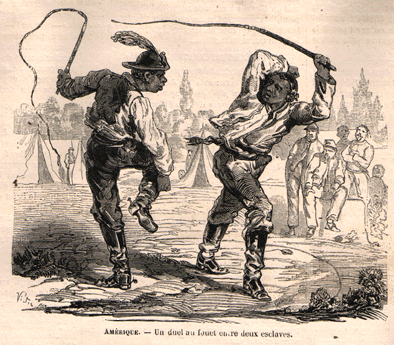
Crazy Image


From the South, one wonders? Those look like army tents.The soldiers having a ball.

from Act One Scene Four


(Austin unloads the rifle. Sets it in a corner.)

Austin: So what have you got there?

(Henry’s wrapped treasure. Everyone sits, somewhat uneasily. Henry hands over the object.)

Austin: All right. What’s this now?

(He unwraps it. First the burlap. Then the towel. Sits back to take a look.)

Austin: Huh.
You know, I hate to disappoint you young man, but I have never known, in a single instance, of a Negro of any moral tone who was fond of the banjar. You won’t find such things up here.

Henry: Oh.

(Henry is crushed. Cole laughs again.)

Henry: Why?

Austin: Why?
Well that’s a rather complex question.

Henry: I’m all ears, Mister Steward. From what I’ve heard, it’s a beautiful instrument, and it’s the one true thing to come out of this meeting of peoples..

Austin: You call the institution of slavery a meeting of peoples?

Henry: Collision of peoples? Look I’m sorry sir. I come for knowledge, that’s all.

Austin: As far as I’m concerned, the only suitable music is that which has been made in praise of the Lord above.

Henry: That’s a hard position.

Austin: Which has arisen out of the necessity to instill temperance into all our fellows.

Cole: So you’re one of those temperence folks.

Austin: I am. In the old days, Mr. Cole, such parties that this little instrument would inspire in some woodland hovel proved a danger to my brethren as well as yours. The revellers would secure themselves against ambush by stringing a line across the path to their party. Any slave-owner who came looking – not to mention more than one curious innocent – found himself maimed or even decapitated by the act.

Cole: Serves ‘em right, I’d say, trying to run the lives of their fellow men, like they were cattle.

Austin: Well that’s a very sensitive remark there, Mr. Cole, but an eye for an eye does not for justice make.

Cole: I still say serves ‘em right.

Austin: Even the innocent who happened to be in the wrong place at the wrong time?

Cole: I don’t imagine any innocent would come rushing fast enough to do themselves any harm.

Austin: Sometimes it would be the horses that were so maimed.

Cole: Oh, in that case. Well, that’s different.

Henry: And you want to blame all that hurt and pain on the little banjo there? You want to banish it utterly from the land because of some old southern party tricks?

(Austin sees the scope of Henry’s disappointment.)

Austin: Well... of course, the climate’s got a little to do with it too. Let me take a look here.
(He picks it up.)
You see?
It’s split.

Henry: What?

Austin: The skin. And the neck is cracked.

Henry: Really?

Austin: Weather up here isn’t conducive to the banjar. It’s an instrument born of the dry southern heat, the heat of the African continent and the State of Virginia.

Henry: So it’s split.

Austin: Yeah.

Henry: I never even got to learn how to play.

Austin: So tell me then: What are your names?

Henry: Our -?

Austin: What do you go by? In this act of yours?

Henry: Er.

(Henry and Cole exchange a look.)

Austin: You do have an act, don’t you? Or do you blacken up your faces with burnt cork for some other reason?

Henry: I go by Liddle Brudder or Long Tail Blue.

(Austin looks to Cole.)

Cole: Me? I’s John Crow.

Austin: John Crow?

Cole: Come listen all you galls and boys
I’s jist from Toronto,
I’m goin to sing a little song,
My name is John Crow.


Austin: But that’s not so original, is it?

Cole: What you mean?

Austin: Is there not a famous cork dancer named Jim Crow making the rounds through the United States of America? ‘cept, if I’m not mistaken, he’s from Tuckyhoe, not Toronto.

Cole: W’ll he’s not up here, is he?
...
Anyway, I never heard of him.
...
What business is it of yours anyhow?

Austin: Oh, I sometimes used to go out for the entertainments, back in the State of New York... Civilization...

(He’s thinking about his wife. He goes into a bit of a reverie. Macey enters. Has a brief conversation with him, out of the past.)

Macey: Austin. When are you going to take us to New York City for own of those high falutin shows?

Austin: They’re having a balloon launch in Rochester tomorrow afternoon Macey.

Macey: Now you know that’s not what I’m talking about–

Austin: And I hear they’re going to be unwrapping an Egyptian mummy right in front of the town hall on Saturday evening.

Macey: Austin. I want to dress up in my finest clothes, and I want to go into a theatre and sit down in a chair to watch a performance of a piece of music, or a comedy...

Austin: The circus?

Macey: No.

Austin: There’s a man named Barnum making the rounds with the oldest woman in the world. Claims to have been a nursemaid to George Washington himself.

Macey: A tent is not a theatre, Austin.

Austin: And then there’s that Jim Crow fellow. A play called Bone Squash or something of that nature.

Macey: Jim Crow? Well... I might be convinced.

(Henry is bringing Austin back to the present.)

Henry: Mister Steward?

Austin: You were saying? My apologies. I drifted off for a moment.

(Macey disappears.)

Henry: I was saying I thought it was – I mean I reckon you would have found those kinds of shows somewhat - er - offensive, or... uh, I thought you said the subject didn’t interest you.

Austin: Thomas Dartmouth Rice, who goes by the name Jim Crow, speaks in the public realm as if he believes he truly is a black man. And has stirred up all sort of trouble for himself as a result. He attracts as many coloured people to his city performances as white. I’ve heard tell he’s the most popular actor in America. It strains credibility to say you haven’t heard of him.

(Henry nudges Cole as if to say, ‘See?’ Austin notices.)

Cole: I -

Austin: I do not fully approve of his brand of low comedy, but the man is forever in my debt for publicly ridiculing the argument that the play by Shakespeare called Othello the Moor is not a genuine tragedy depicting the fall of a great man, oh no, God forbid, but rather a cautionary tale of lust between races - the latter opinion popularized by no less a personage than former President John Quincy Adams.

Henry: I thought John Adams was against slavery.

Austin: He is against slavery. He is also, it seems, against the notion of the so-called uppity Negro.Mister Rice may show a lapse of taste when he blacks up his face, but his heart is the heart of an emancipator, no less than William Wilberforce himself. Of course, the same cannot be said for his many somewhat crass and bigoted imitators.

Cole: I ain’t no imitator. I am myself alone.

Austin: Well, let’s have a look then.

Cole: I beg your pardon?

Austin: I would like to see your rendition, your interpretation of the Negro.

Cole: No thanks.

Austin: I abash you then.

Cole: Pf. No.

Austin: But isn’t this what you want?

Cole: What’s that.

Austin: To top our famous Mister Dartmouth Rice? To embody the genuine black man in a kind of transubstantiation? To get the edge on that upstart New Yorker Jim Crow, even as you all strive to beautify yourselves with our feathers?

Henry: Er.

(It’s clear this is exactly what Henry wants. Cole laughs.)

Cole: (re Henry) This one does. He does.
(Henry smacks him.)
Hey - You do!
He came all the way here into this god-forsaken wilderness because he thought he might absorb a little of the true, unadulterated l’esprit de Negro. And he dragged me along with him.

Austin: That true?

Henry: Er.

Austin: Show me.

Henry: Er.

Austin: Sing for your supper, and I’ll see if I can’t give you some assistance in recreating through your art the legitimate, genuine Negro.

Henry: Are you proposing... ?

Austin: An evening’s idle entertainment. I’m expecting a call somewhat late. I have to find some means to abbreviate the hours.

Henry: Er.

Austin: Don’t worry. You needn’t bother with your cork. That’s your surface, that’s your gloss. Give me a little number.

Tuesday, December 20, 2005

The Problem with the Long Neck


It throws my lower back out. The lumbar region. If I'm not careful. Especially in combination with motorcycle boots. That's what I get for trying to learn two new songs in a week. See, this is precisely why I'm not a professional musician. I don't want to suffer for my art.
By the way, Running Up That Hill is in C-minor, and there's a D-sharp drone that runs all the way through it. So naturally I'm playing it in double-C tuning with the 5th string tuned down to D-sharp. Trying to play melodically with as many chords as possible, to keep that driving sense of rhythm. There are some beautifully dissonant chords. It's going to be a favourite. But I'm going to have to go see a chiropractor first.

From the Celestial Monochord


Part of a promised series on banjos and repression. The rest yet to come.

Monday, December 19, 2005

A Pastoral Visit


Painted in 1881 by Richard Norris Brooke. From here and here, thanks to the anonymous commenter a few posts back. But wait a second. Where's Steve Martin? Didn't he invent the banjo? They sure don't look happy like Steve Martin. Banjo players play permanent bluegrass, with permanent grins glued to their faces, or at least that's what I heard.

Saturday, December 17, 2005

News from Wilberforce


A letter from the Blyth Festival out on the West Coast of Ontario, near Lake Huron:

Mr Dix,

Just was thinking of you...realized I have never responded to Wilberforce, and imagined the anxious ether that surrounds such auspicious hand offs. I adore it. I would love to hear it read and think we should push Eric for a reading next summer, (if you want to). I'm not sure how to specifically articulate it, but I love the style of it, the cadence, both in terms of language and scene structure, it flows with a particular lilt that I think has the potential to be deliciously potent. I don't know if you're looking for specific feedback, or if Eric already has you on a regime of dramaturgy, but I just wanted to throw that out there.

Hope you guys are well,

Gil

PS The Perlman Clawhammer book is pretty fantastic, I started around Liberty and at first I was moving forward but I since have backed up some and picked up some excellent tunes, Soldier's Joy, Last Cold Whiskey, Bill Cheatum, June Apple, great fiddle tunes.

Friday, December 16, 2005

Next Up


Is it even possible to play Running Up That Hill on Clawhammer Banjo? I tried to find a big pot to step on with my foot to make a boing boing sound to replicate the simulated horns in Kate Bush's song, but the pot in my house that used to do it doesn't do it anymore. A change in the weather I guess...
Anyway, I'm working on it. C-minor? E-flat major? Who the hell knows...

ps I've just found a site that confirms there are no banjos in Kate's music.

Thursday, December 15, 2005

Back in Banjo


Sorry. Sorry. Sorry. Sorry. I've been away in actor-land and teacher-land all fall. There is much to say about teaching I suppose, but now is not the time. It has also been so long that I took a good look at the long neck that I found it bowed almost beyond belief. It took several days of truss-rod turning (clockwise!), plus half a Yukon Gold potato with the banjo in the closed case (yes I do that, and it doesn't smell or rot, it just dries up nicely until it's like a rock, only somewhat softer), plus a few short prayers to - um - Uncle Dave Macon? to make things right.

I've returned to the blogosphere though mostly to celebrate a new song I'm learning to play for a wedding on Saturday. It was written in 1966 by a feller name a Roger Miller. It's called Husbands and Wives and sometimes the only way you can celebrate someone's happiness is by singing a sad song. It's got a very sweet progression that's made me a somewhat better banjo player just by the effort to grasp it. There might be a few dissonant notes in my chord stylings, but I like dissonant notes. My banjo wouldn't be my banjo without them.

Here are the words:

Two broken hearts lonely, looking like houses
where nobody lives
Two people each having so much pride inside
neither side forgives

The angry words spoken in haste
such a waste of two lives,
It's my belief pride is the chief cause
in the decline in the number of husbands and wives

A woman and a man, a man and a woman some can,
and some can, and some can't.


And then it just repeats. You could go on and on with it forever. And believe me, I already have. Kat's sick of it.

Oh yeah, and the image above is from here. It's been so long I'd forgotten how to do that 'a href' stuff. Seems to me that bit of stitching, while nice, looks more like me than Roger Miller.

Monday, September 19, 2005

We're In The Movies (High Rez)


Here.
So high, I can't even see it. Don't have the proper software. QuickTime 7. But you can, hopefully.
And here, if you don't have the software either.
And for those who have just arrived, I'm referring back to this.

Saturday, September 17, 2005

Sheet Music


Click on each of the sheets and you'll get a larger image that you can make larger still with yet another click. The music is perhaps unnecessarily complicated. I didn't know how to simplify it. (A lesson in how complexity can sometimes indicate a dearth of skill...)
p.s. I should mention that this sheet music was first published, hard as that may be to believe, in This Magazine.

'Nuther Armstrong


The other was recent. This one is a portrait of me, from about 20 years ago...

Friday, September 16, 2005

We're In the Movies (low rez)


Here it is. A gift from Kat on my birthday. The compression leaves something to be desired, but we'll fix it later. And here's the stand-alone. A slightly better quality one will be up soon.

We shot this last winter. Kat found a dancing school that gave us permission to shoot their class.

I know, I'm such an effing greaseball in it (I'm almost glad the compression makes the quality poor - it's as grainy as a cheap porn movie, or I suppose I should say as digitized), but it was only meant to be a demo for a more sophisticated, shampooed and made-up short film, starring Michelle Girouard and E. J. Scott, a bunch of kids and summer, and some underwater ballet dancers - I wasn't even going to be in it at all (except my banjo, my banjo was going to be in it), but the Bravo Fact people took one look at our CVs (playwright/documentary filmmaker) and didn't even look at the demo. They returned our application virtually unopened. I suppose I can't blame them. Anyway, if they had looked at the demo, they might have been horrified by my Charles Manson hair.

The bass player who magically appears is James Thomson.

The song 'We're in the Movies' was written by a character named Priya in my play/novel The Girls who saw Everything, (soon to be published by a small press near you, or rather, near me) who is a girl in Montreal, part of an exclusive book club, who imagines an audience following her wherever she goes, and uses them as a spur to write her songs. The video was going to be about that.

This one, the demo, is more about the images in the song itself. It's nice enough, except the greasy, growly vocalist. The filmmaker is clearly a master, and I have at least one friend who has expressed horror that I've taken advantage of her to put my little song on video. What can I say though? The little demo was a Valentine's Day present, and now the online version is a birthday present. In case you can't make them out, here are the words:

No matter what we do we will always be young
like a book where you're always going back to page one
say we're chased by a killer high tail it and hide
he sees us he runs in he's gone

then the future creeps by with its executive.
but we know that to work is the death of to live
till a man comes along from...
builds a marquee up above um...

sets up a booth sells tickets to our youth
cause we're young
and we're young
and we're young!

but for me though it's much different from that
no matter what I do I will always be old
I might swim and win medals (always be old)
know the rules of resistance (always be old)
tread on the boards send letters of love
still old in a raincoat old on a bicycle
Riding past the marquee...
(With a film from the past two thousand BC)

And I'm young I'm 19 when I look at that screen
But I'm old
and I'm old
though I'm young!

At the end of the film there's so much to discuss
As we try to figure out just what happened to us
Did we win? Stay together? Did we cry? Did we pray?
Did we find we worked hard by the end of the day
Were we good? were we ill? in the movie, did we kill?
A conviction, an appeal, was it fake, was it real
Or maybe we just got one heck of a deal,
And if you want more well there's always to-
morrow and tomorrow (if to-
morrow comes tomorrow then to-
morrow can be borrowed for to-
day, that's our way), cause..

No matter what we do we will always be young
like a book where you're always going back to page one
cause a man came along from...
built a marquee up above um...

set up a booth sold tickets to our youth
cause we're young
and we're young
and we're young!

Albert Polman


It's my birthday and I'd like to pay tribute to my greatest teacher, Albert Polman, who died Tuesday evening of a heart attack on the couch of his Brantford home. I saw him this summer, visited him on a whim, with Kat, who tells me she could see how special he was in that one brief visit. I'm so glad I saw him. I'm glad he never had to vacate his art-filled kingdom, with it's vast lawn covered with trees and statues of little animals and icons of St. Francis.

And as fellow student Laurie Armstrong (whose image is reproduced above) wrote in her message to me about it,

Cheers to my fiesty, eccentric and ultimately lovable Sir!

Go visit the people that reminds you of.

p.s. when I visited him, he told me that in 92, a couple of years before he retired from teaching, he got very depressed. He was depressed for ten years. Then one morning, about 3 years ago, he woke up and it was over. He was full of the brio and zorba of life again. So the last three years were full of projects and his only regret was his age-old one that there just weren't enough hours in the day.

Wednesday, September 07, 2005

Megaphone

I just got one. On ebay. I was going to illustrate this post with a photo (because why would I not?) but, for some reason, my browsers won't let me upload or link photos anymore. Am I being punished? Have I been abusing the system? Did somebody rat on me to the Blogger gods?

When I told the head of the acting program about my new purchase, she wrote back,

You WHAT?!!!! Do you really want one for yourself? Of course, you'll be loud but that's OK - I don't intend to be next door! Let someone else suffer!!!

Funny, hey? Now I have a megaphone. What better singing teaching tool can there be than a megaphone? Just ask Tom Waits.