Wednesday, August 31, 2005

Answers to Recent Banjo Banjar Mysteries

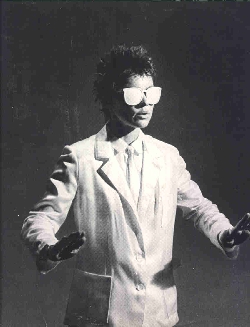
Just found out who the Girl Banjo photo was of. Though I can't seem to open her own web page. Ooops. Just did it. Can't find any banjo on the audio stream. But I do like the song The Golden Dream. The photo is from the back cover of a 2000 CD called Distillation apparently. Still doesn't explain how she got those fluevogs. I have the exact same pair, but mine are plain black with some white thread to subtley indicate the pattern. I wanted to get the colourful kind, like the ones she's got, but I got talked down by the person who accompanied me to the Fluevog store in Vancouver in September 1999. If you're out there and you know who you are, you ought to be ashamed of yourself.

No. It was my own fault for being impressionable. The Malleable Personality. That was, as it turns out, the subject of my Trampoline Hall lecture. As opposed to Banjos and frogs.

(oops. I've been accused on my Banjos and frogs post of being a

It's interesting, considering the image that I stole was actually stolen by them first - since I have the original image of that frog playing that banjo in beautiful print from this book, for Hance Brothers and White throat lozenges - from the 19th Century. The print is a photo of a 3-dimensional window-display ad. Let me see if I can find the picture. Oh. here it is. My favourite pic of a frog and a banjo.)

But back to Fluevog, I'm wondering if the shoemaker himself is still asking people to write 500 word essays called 'How I saved Mister Fluevog from the clutches of the devil', or some such thing, in exchange for fluevogs for life. These shoes, such as what Erin McKeown and I have (mine more conservative and hers less) are called 'Angel shoes.' It's because they have the image of 19 angels on the sole of each shoe, if you can believe it. Treading on angels. Or at least treading with the moral support of angels. That's what M. Fluevog would have us do...

Sunday, August 28, 2005

Banjo to the Pole


Hussey's banjo recitals were a feature in the swift raising of spirits: 'Had a go at the old Banjo. The Boss came in, he looked very old & grey - & pleased to hear the music & songs'. And although a glance in a mirror gives the usually optimistic Hussey pause for thought ('I do look a tramp!'), from only a few days after its gloomy beginning the journal manifests the extraordinary confidence and belief that characterised the expedition's survival: 'We're all very cheerful & contented'.

One of Shackleton's men on his expedition. I had no idea. His diary was up for auction I guess.


And more from this site:

James, in Shackleton's tent, "did some physics trying to recall some of my theory work," but soon tired of it. The occupants of Wild's tent had to shift their sleeping bags because the heat from their bodies was melting the snow, robbing them of this last bit of comfort offered by a dry place to sleep. Even Hussey's banjo lost its appeal for some. McNeish complained: "Hussey is at present tormenting [us] with his six known tunes on his banjo."

Another One More


And thus I have cleared the backlog in my image file for the 'jar.

One More

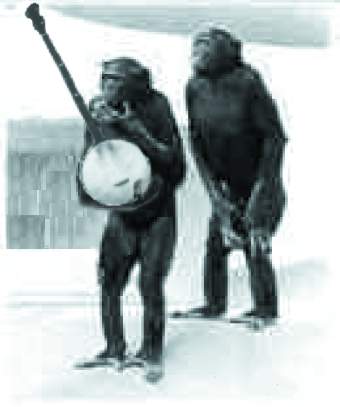
Monkey Banjo


Girl Banjo

Boy Banjo

The Painterly Arts

Patent Art

Thursday, August 25, 2005

Teaching


I was recently expressing fret and worry to my old friend Jan Zwicky about the fact that I'm coming up to a semester of teaching for the first time ever, that I don't feel exactly qualified about what I'm going to teach and that I don't know how to organize the program. She wrote back:

"Teaching is just improvising on the theme of truth. You'll do great."

Wednesday, August 24, 2005

Gravity's Banjo


It has been suggested that I adapt Thomas Pynchon's Gravity's Rainbow as an opera, since Laurie Anderson cannot accept Pynchon's limitation that it be composed for solo banjo.

Since I wish it to be no secret that I am a lifelong fan of Ms. Anderson's oeuvre, I'd like to submit, in support of her desire to expand the musical palette, that we make a counterproposal to the effect that Gravity's Rainbow be composed for banjo and fiddle, a sibling match if there ever was one.

Speaking of sibling matches, those two look related, don't you think? Look at those eyes! Look at those noses! Look at all those beautiful shoulders! Thomas Pynchon! Have you got an illegitimate daughter? Is this the nature of your challenge? Sew a cambric shirt? Seed an acre between the salt water and the sea strand? Compose an opera for solo banjo? Reunite the daughter and the father? What are you afraid of, Mr. Pynchon? From whom are you hiding?

It's time to stop running, step out of the shadows and declare your paternity.

Monday, August 22, 2005

Banjo Banjar's New Look

For fall.
Don't forget to click the safe colour box. Otherwise the internets might explode into a miasma of nasty coloured microbots.

Ghost Waltz


The song Ghost Waltz by Jolie Holland features both an old-timey banjo and a saw. I'd like to link directly to the mp3, in the manner of your bona fide music blog, but Zoilus told me it's a bad thing to do. It eats up... um... it eats up something... Cyberspace? No, it can't eat up cyberspace. Bandwidth. Yeah, that's it. It eats up bandwidth.

A Pretty Small Concern


I was in Soundscapes the other day, listening to Jim & Jennie's CD, River's Roll On By, which features a beautiful, notable cover of Dock Boggs' Red Rocking Chair.

There's another song on there, a nice bit called Mt. St. Helens. Beside the listening station, the store had posted the Pitchfork review of the album. It's a nice review and maybe I'm quibbling, but where is the harm in writing about something that has both a literal and a metaphoric meaning? It's been bugging me for days.

He writes,

Jim and Jennie split their time between stark ballads and rollicking, banjo-fueled stompers, both played with aplomb, and there's rarely a misstep. When there is, it's usually subtle-- for instance, the lyrics to "Mt. St. Helens" feel like they ought to be metaphorical, but they instead are literally about living on Mt. St. Helens, a topic that feels more random than apropos.

Mister Pitchfork calls it a pretty small concern, but I have a somewhat larger concern about the way Mister Pitchfork evaluates the art that comes his way. What did they teach him in highschool, one wonders, and why hasn't he forgotten it yet?


Here's Dock Boggs and a cat. I don't know why the image has been copied three times, but I like it. One might find a mind-blowing two layers of meaning in such a triple-image, but I doubt it. Joe Tangari can feel safe here, on this blog of solo meanings. It's from this site.

Oh but now that reminds me of a piece of graffiti I saw the other day near the railroad tracks above Queen Street west of Dufferin. They're my favourite streets there but I can't think of what they're called. A pair of L-shaped streets. The graffito went something like this:

The numerology of the heart is binary: All ones and nothings.

Saturday, August 20, 2005

Leading to the Question...


What is it with frogs and banjos?
It was going to be my subject of a Trampoline Hall Lecture way back, but at first it seemed the connection was just a no-brainer. It just was what it was...

Whatever the answer, it seems to lie in these parts here:

Apparently the red star indicated where the banjo frog can be found, at least in November 1999. I don't know what the green stars indicate.

More Art


From Dogwelder.com

Tarbooosh II

Enough of these pictures of self. Here's an image courtesy of Robert Greene. Used by permission. For once.

Friday, August 19, 2005

More!

Another banjo portrait.

And this is Kat. In Greece I think

Nuther One


Courtesy of Kat...

I just discovered this


Picture courtesy of Hugo Dann in his friend's Montreal apartment, uploaded straight from my computer. It's my favourite banjo portrait. That of course is the beloved Deering Long Neck. It seems I don't have to steal images from other sites anymore. But the question remains: Does Flickr provide better quality?

The Sound of Banjo Boya


Here's the English translation, courtesy of Google, without assistance from me. I can't hear any banjo in there, but it sures sounds good...
And here is the original web page.
Actually, upon further examination, I don't think this is Banjo Boya's Band, but rather another band called Southern Train. But they have Banjo Boya's support, and so they have Banjo Banjar's support too...

Charlie Poole


Possibly the best early banjo collection I've ever heard. Carl's got a nice review in the Globe and Mail, but you'll have to pay for it at this point.

(The Guardian, the Independent, and the New York Times – even its Magazine – can all be perused for free at your leisure, but that flying buttress sailing so nobly above the column, that towering colossus of International Journalism, the Toronto Globe and Mail, home to Christie Blatchford and Marcus Gee and Leah McLaren, makes you pay. They ain't talkin to me I guess, and I ain't talkin to them.)

Not only is this an exhaustive collection of Charlie Poole's music, but it also includes the players that he liked and listened to, the players who listened to him (including David Macon) and, most edifying of all, earlier versions of songs that he adapted, side by side with his interpretations. It's all spelled out in the accompanying booklet. All in all, a beautiful structure. One might go so far as to call it a flying buttress above the towering column of early banjo-recordings, etc. It tops the earlier Dock Boggs collection, which is saying a lot.

More on Hedy West


I grew up with a big Folkways Collection of records that made a big impact on me and brought me inexorably to the banjo and the clawhammer style years later in my adult life. The collection included Hedy West singing Cotton Mill Girls, a song and a style that stood out with clarity, simplicity and beauty from what was already an impressive collection. I learned the song pretty much by osmosis and later played it on the banjo, straight-up frailing.

Then later, for awhile, I had an instruction book by Ken Perlman called Melodic Clawhammer Style banjo. There were contributions by various banjo players in there along with their pictures. But there was also a great pic of Hedy West without any accompanying tab. I always figured he included the photo because she was so beautiful, though I always wondered whether there'd been a tab that got cut out in the editing process.

Those were the only two things I knew about Hedy West. I used to sing Cotton Mill Girls all the time, with Brendan Wall and Anne Lederman, as part of the pre-show warm-up to our outdoor extravaganza on the life of the Donnellys that we did in Blyth. Like many people, I assumed that I had learned this song from Hedy West but that she had not written it. I assumed it was traditional. But it wasn't. She'd written it. It was her song.

That's the best I can do for an appreciation. Wish I could do better.

Thursday, August 18, 2005

More of the Musical Saw


A couple more images of the musical saw, since I couldn't find a good one of Melissa Swingle for my review.
The top pic is Marlene Dietrich, of all people, from a German site.

And this one shows the essential curve to get the full range of notes, in silhouette...

And this one's just the best...

And here's Melissa Swingle, with the essential car trunk but without the saw...
And that's a post...

Cox


I had 42 hits yesterday, and a comment deep down in the posts from this banjo player. She must have a lot of pull.


That's her CD cover up top. I like that song Rachael a lot.

Wrong-Eyed Review


Carl asked what I thought of that movie. I think he's trying to coax me to be a better blogger. I answered him in the Comments section, but Kat has convinced me to make it a bona fide post. So here it is.

I didn't like it at first, and it ultimately wasn't what it claimed to be - that is a musical odyssey through the south (or perhaps that's merely what I claimed it to be?) since the same faces kept popping up over and over again - primarily the Handsome Family and Johnny Dowd. But it did have something - I'll get to that in a minute.


Very nice was Melissa Swingle showing up and playing the saw like a master, and then telling a sad and funny story without a HINT of mirth. Almost worth the price of admission that was, right down to the two figures who walked out of the woods to listen to her play. I knew that was staged but I didn't mind.


A lot of stuff was staged, in fact, in the beginning, and I wasn't sure I was going to like the company of Jim White. But he grew on me. The movie was more a reflection on the hole that religion fills down there than a musical cornucopia, and he was really good at talking about that; there was only just enough live music in fact to make you reflect that music is a more tasteful, subtle and hell I suppose artistic means of filling that hole.


Near the end there was an interview with old man Lee Sexton as he spoke of working in the mines and playing the banjo to lift his spirit, and you believed him, and he also spoke of all the good banjo players who had died, including (it sounded like) his own father and his own son. I thought, if this wants to be a Southern Musical Odyssey, it's got to have a lot more stuff like this.

I think a true Southern Musical Odyssey wd have to be a whole series - like the Civil War Mini Series. This format could never really capture it all, no more than Oh Brother Where Art Thou. Making Johnny Dowd and the Handsome Family follow them around through the south had the opposite effect of what they wanted. Not that there's a master in every county, but that there are these few cuty-pie weirdos lurking around the whole place. No matter how good they were. Funny - it was the same flaw in Oh Brother.
Made me reflect on just how good The Buena Vista Social Club really was - that movie could be called Shakespearean in its scope. Seems like a weird thing to say about a musical documentary about Cuba, but it really was a unified portrait of a whole society (it seemed) of musicians, from the kings and queens down to the fops and the grooms.

This one clearly was made with love and a lot of cranes. Maybe they would have driven further if they'd used a smaller camera.


Still, it was good. Kat liked it a lot. As a portrait of southern religion it was actually quite profound and chilling. A woman preaching in a diner about the murderer who could already feel his feet burning before he died; the chinless radio-preacher who had such uncanny power that she nearly had the audience in the rep cinema speaking in tongues; and the visions of people speaking in tongues themselves, something I've never heard before. The characters in this movie want to convince you about the reality of hellfire, and they have such authority in the matter that they very nearly do, certainly more than anything else I've seen...


Soundtrack was great though. No doubt about that.