Carl
Carl has weighed in
thoroughly on the subject of The Subject of Minstrelsy in Current Music Crit thinking, quoting my
recent post
unnecessarily, because he is my
friend. Among other hypotheses, he puts forward the intellectually satisfying idea that the discussion may have arisen as a natural evolution away from the Cultural Appropriation debates of the Eighties. And he speculates that the next wave will analyze the
roots and the
roots and the
roots and the
roots of these
roots of American music.
Roots of roots got me thinking of what
Robert Hemenway said about
Joel Chandler Harris and
Uncle Remus and
Brer Rabbit in his introduction to the
Penguin Classics Edition. Uncle Remus, Harris' invention, might have been as white as Harris was, and very much a product of the times, but Brer Rabbit is an altogether older figure:
A fictional character, Uncle Remus was created by an author with a sentimental attachment to a plantation memory. Bald, bearded, bespectacled, Remus is a former slave who does odd jobs around the plantation after emancipation. He tells his stories night after night to a little white boy, son of the plantation owner, unfolding to him in grandfatherly fashion the "mysteries of plantation lore." Remus has, Harris tells us, "nothing but pleasant memories of the discipline of slavery." This fictional creation of a white Southerner was welcomed by an audience that wanted to believe Remus was a representative of his race; Uncle Remus is a cousin of those 19th Century minstrels who blackeded their faces to entertain with jokes and songs. He is, in a way, white.
Brer Rabbit, on the other hand... had been a staple of Afro-American folk expression prior to 1880... Shaped by a long line of oral artists. Brer Rabbit is black from the tip of his ears to the fuzz of his tail, and he defeats his enemies with a superior intelligence growing from a total understanding of his hostile environment. He is the brier-patch representative of a people living by their wits to make a way out of no way.
These two images, Uncle Remus's semiminstrelsy and Brer Rabbit's cunning tricksterism, complicate the interchange between tale and teller in Harris's famous book. Uncle Remus is literature, artifice, a Victorian relic whose plantation manners embarrass the modern reader. Brer Rabbit is folklore, a communally created universal outlaw whose revolutionary antics satisfy deep human needs. Joel Chadler Harris works between the two of them, investing a part of himself in Uncle Remus, struggling to understand Brer Rabbit's appeal.Now, I always feel a little uneasy writing about this stuff, because I have a hard time distinguishing between objective analysis and more emotional (reactionary?) content. Hemenway wrote that essay in 1982. Can you tell? It's the appropriation-discussion decade. So is there any chiding in it? Is it claiming that Brer Rabbit is more authentic than Uncle Remus? Or merely older? I can't figure it out.
I'm wondering about this because I
posted earlier of my admiration for Michelle Shocked having the desire to put the image out there of herself in blackface. This was in 1992, just a year before Eric Lott came out with his seminal
Love and Theft. I guess there was something in the air, which is why Carl's idea connecting it to the post-appropriation decade is so satisfying to me.
After posting though, and with an ass-backwards way of doing things, I decided to make sure I had my Shocked facts straight. I discovered almost immediately that she gets chided (by Mark Deming) in this little
capsule for wading into the debate without any real understanding of it. That got me wondering whether I was wading into the debate w/o having any understanding of it. Because, as I see it, Michelle was making a direct expression of her own
Love for the form and a simple acknowledgement of the
Theft. Or, rather, she was
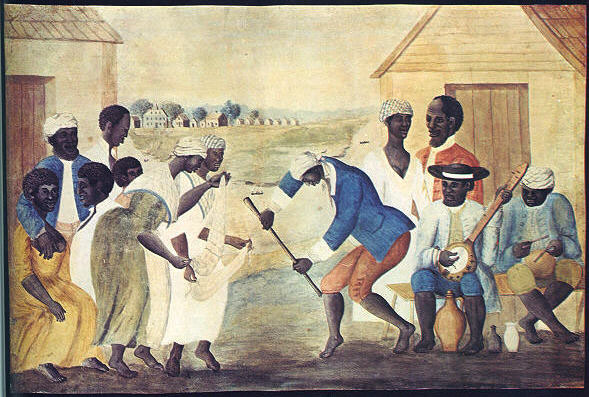
failing to do this, proving that while talk on the subject is maybe okay, action is maybe (maybilly?) not. Illustrations are acceptible if over a century old. Otherwise problematic.
Shocked may not have had the critical faculties to finess her desire into words (or even to get her collection of favourite songs produced with the raw sound that might have gotten it embraced as an early alt-country effort, like her own earlier
Texas Campfire Takes), but her desire to use her own face to express that old American cultural collision was intuitively right on. Admirable, as far as I'm concerned.
Again, I'm embarrassed about this, b/c I feel like I'm entering an argument long since resolved, long since forgotten. But here I am! I have a voice! Hear me roar! Etcetera! Or (as my Microsoft Word Dictionary would have it) Etceteras!